'Whose Play Is It Anyway?' Returns for 2025
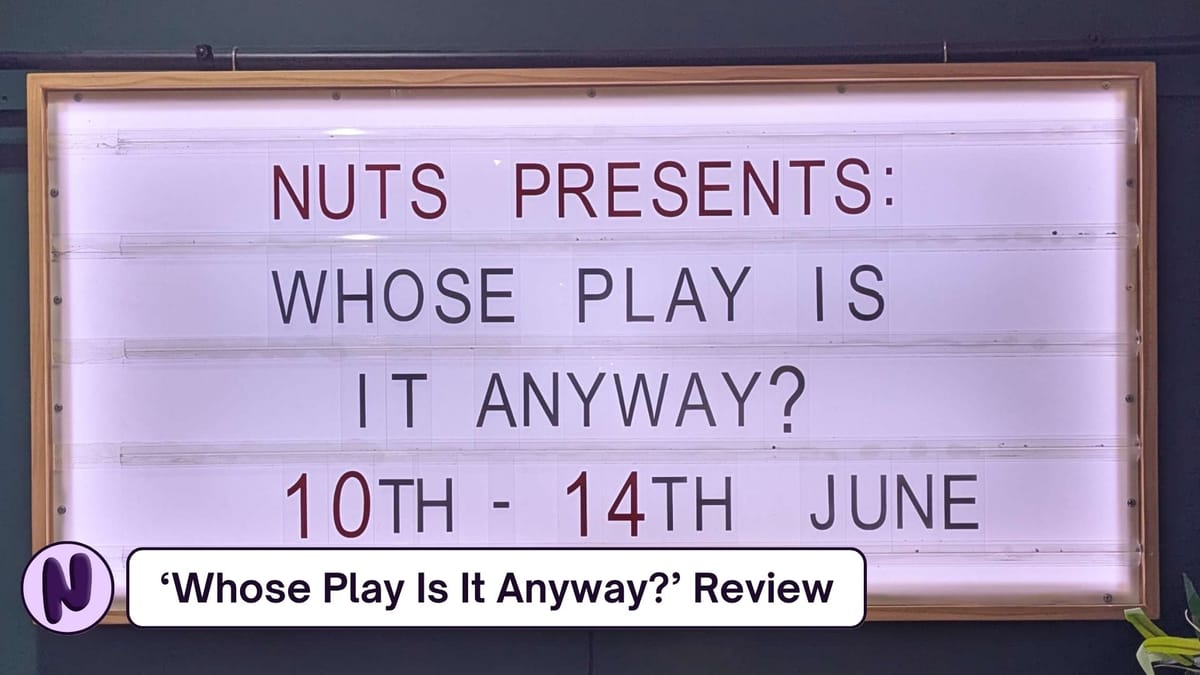
And so, it’s that time again. Winter is setting in, Sydney is lit up by Vivid, and the UNSW Theatrical Society (NUTS) is putting on a series of shorter plays written by UNSW students. I attended the performance on Thursday, June 12, catching three of the six shows that were cycled through across the project’s five-day run.
Homo Homini Lupus written by Jack Batchelor, directed by Eliza Jones
Beginning with the timid Luke (Alec Gibson) enrolling in a high-end all-boys private school and meeting his dorm mates, ‘Homo Homini Lupus’ follows the young man’s struggles with the various forms of bigotry and toxicity perpetrated within the school's halls. It’s a solid start to the evening, making an earnest stab at social commentary and earning a few laughs from the exaggerated personas on display.
The play effectively tells a character-based narrative in a concise yet powerful way, using vignettes of the quartet’s interactions at their boarding school, interspersed with letters sent between Luke and his sister Emma (Zamika Grant) to seamlessly move the plot along.
Luke’s dorm is ruled by the brutishly boisterous John (Trinity Ray), enabled by his sometimes reluctant rugby mate Christian (Isabel Hathorn). Also in the dorm is Berkay (Bora Celebi), a seemingly gentle soul who accepts John and Christian’s racist jabs as friendly banter, because the alternative is more painful.
Berkay was the character that stuck with me the most from this play, partly because of Celebi’s excellent performance, but also because he best encapsulated what I thought was the most interesting point of the show. Seeing how the character was shifted by those around him between the in-group and the out-group, threat and ally. It captured something truly fascinating about how such hierarchies can form in these conditions, and how much of themselves a person can sacrifice to avoid being pushed any further down on the ladder of society.
The rest of the play chugs along admirably, though it sometimes felt a bit too obvious – John’s rant against left-wing pronouns and feminism, for example – but perhaps that’s fair. Entitled teenage boys aren’t known for the subtlety of their speech or the nuance of their views. Still, at times the writing feels it could have benefited from a touch more depth and specificity.
All in all, it’s a play with good writing, a solid cast, and a topical issue explored reasonably well.
Lead written by Eliza Hoh, directed by Katherine Vu
Getting straight to the point: ‘Lead’ was incredible. Hilarious, moving, and fascinating. If I could, I’d see it again without question.
The play centres around the anxious and overworked David (Renzo Alcordo), as he attempts to balance his responsibilities to his ex-wife Lou (Anastasia Dougenis), his daughter Ellie (Grace Sung), his boss Mr Hugo (Finn Sargeant), and himself.
Opening with a constant stream of witty dialogue and a dash of physical comedy, ‘Lead’ absolutely starts out on the right foot. I was hooked, and the laughter coming from the rest of the audience indicated they were as well.
To my surprise though, the fast-paced comedy mellowed out around the halfway mark and subtly transitioned into a strangely moving exploration of compulsion, grief, and pen licenses. We learn about David’s sorrow over the loss of his mother, his obsession with work, and his struggles with obsessive-compulsive disorder. It’s well done, managing to strike an emotional chord whilst never quite relinquishing its brilliant humour.
David, Lou, and Mr Hugo all play incredibly well off of each other, and are each portrayed perfectly by their respective actors.
Sargeant imbues Mr Hugo with a wonderfully deranged energy, which contrasts perfectly against David’s humble sincerity and turns every scene the business executive appears in into a truly surreal experience. Meanwhile, Lou is officially the queen of one-liners and side-eye, keeping those around her grounded and the audience in stitches.
Successfully walking the thin line necessary to be funny whilst still treating important emotional issues with the gravitas they deserve, ‘Lead’ is an impressive piece. It’s moving, it’s fun, and it’s side-splittingly hilarious. I’m genuinely excited to see what the people behind it do next.
Royal Blood Stains the Bowl written by Ella Vanderzwan, directed by Astra Milne (ast. Miah Tito-Barratt)
The final play of the evening departed from the contemporary settings and issues that dominated the first two performances, presenting us with a medieval fantasy piece about family, ambition, and murder.
‘Royal Blood Stains the Bowl’ revolves around the struggle between the traditionalist queen Elasha (Olivia Harris) and her reformist daughter Arnik (Ines S.L), with the younger princess Keira (Charlie Scanlon) torn between the two.
The performances are solid across the board, and I thought the clothing, makeup, and set design were all great.
Unfortunately, the play struggles to differentiate itself, at times coming across as an attempt to write a Shakespearean drama by someone who has never seen or read a Shakespeare play. We desperately lack context and depth, as the royals act out their melodrama with unclear stakes and shallow morality, all while taking themselves far too seriously.
There is an ambition to the play that is commendable, and with a bit more work it could have been a reasonably engaging drama. Regicide is a commonly revisited theme of theatre for a reason.
But sadly, ‘Royal Blood Stains the Bowl’ was the weakest of the plays I saw that night, failing to fully meet its potential or engage its audience. It’s impossible to be too disappointed with it though, as it is also the shortest of the plays I saw, and the actors all approached their roles with admirable sincerity.