UNSW's rising academic misconduct

UNSW’s Conduct and Integrity department published a report in September of 2025 titled “Student Conduct and Complaints 2024,” which provided insights into the incidences of plagiarism, breaches of the UNSW Code of Conduct and Values, and student complaints across the last few years.
Notably, the report states that the total number of plagiarism and misconduct cases last year increased by 43% from the year before. The university outlines what actions it will take in response to this rising misconduct.
So what types of academic misconduct are on the rise?
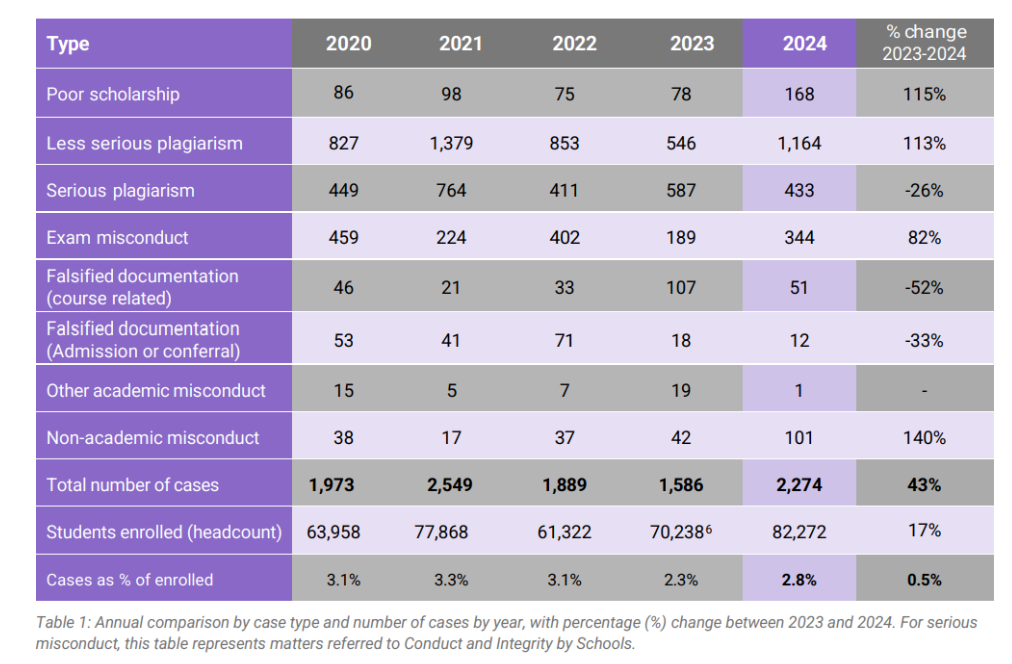
This table provided in the report shows the number of cases of plagiarism and misconduct since 2020, separated into categories, and the percentage change of these cases from 2023 to 2024. Notable trends, as highlighted by UNSW, include:
- An 115% increase in poor scholarship (defined in UNSW’s Plagiarism Policy as a lack of academic rigour as a result of inexperience or carelessness rather than a deliberate attempt to pass off others’ work as one’s own e.g. insufficient or inadequate referencing and/or citation), and a 113% increase in less serious plagiarism (parts plagiarised but not significant to the outcome, like minor copying or collusion or minor misuse of generative AI when not permitted/without acknowledgement).
- An 82% increase in exam misconduct (which, according to UNSW’s Conduct and Integrity department’s page on “cheating” includes using unauthorised materials during an exam, like notes or electronic devices to look up answers, and copying answers from another student or online source).
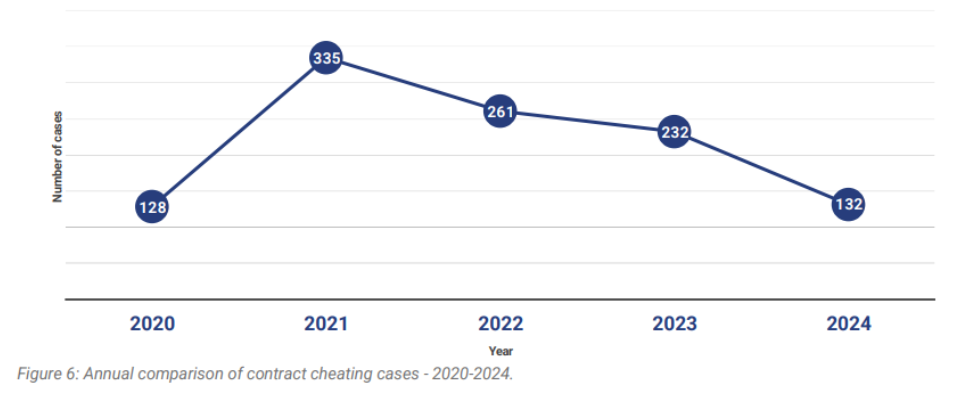
- A 43% reduction in cases of contract cheating in 2024 compared to 2023 (which involves engaging a third party to complete an assignment, quiz or exam for you).
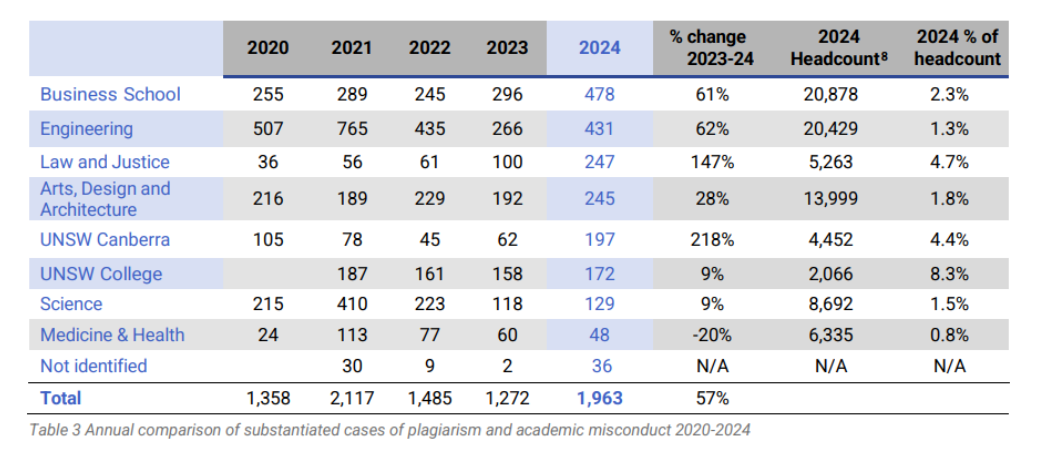
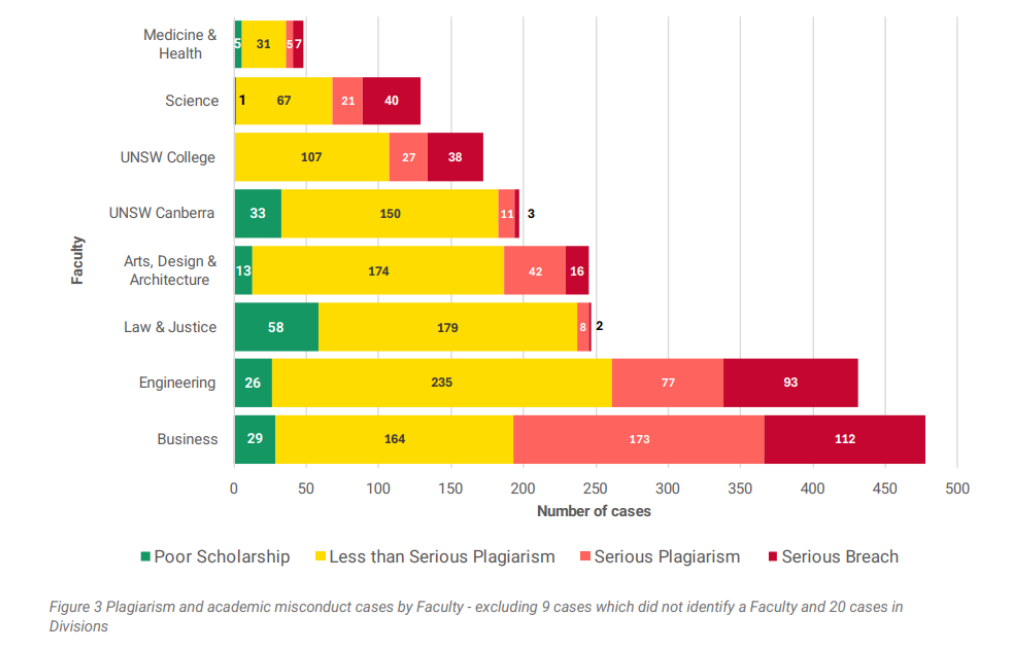
UNSW’s Engineering and Business faculties account for the most cases of academic misconduct within the university overall. The Business faculty has the most cases of ‘serious’ plagiarism identified, whereas the Engineering faculty has more cases of less serious plagiarism. Something of note is that UNSW College (which is the UNSW department that offers diplomas and foundation studies), despite having fewer total academic misconduct cases than the Business and Engineering faculties, has the highest percentage of cases per student (8.3%), which equates to roughly 1 in every 12 students. Furthermore, the report provides a list of the top 5 courses with the most cases of academic misconduct, which are mainly commerce and engineering courses. These figures consist of all substantiated/partially substantiated cases of plagiarism and academic misconduct on record for the course. These five courses were:
- Responsible Business Professionalism (MGMT5050) – 104 cases
- Algorithms and Programming Techniques (COMP3121) – 76 cases
- Principles of Programming (COMP9021) – 55 cases
- Global Business Environment (COMM1150) – 52 cases
- Business Decision Making (DPBS1100) – 51 cases
Why is academic misconduct on the rise?
UNSW isn’t the only university where reports of academic misconduct are increasing.
The Guardian, in an article last year, asked 38 public universities to share their plagiarism figures; only four responded (UNSW being one of them). The other three universities that gave figures were:
- The University of Sydney, which reported 1,879 cases of potential plagiarism in 2023, including 940 reports of potential contract cheating and 352 reports of suspected unauthorised use of AI.
- Deakin University, which reported a 5.76% decrease in plagiarism but a 221% increase in contract cheating between 2021 and 2022 (from 232 cases to 514).
- Swinburne University, which saw sanctions for academic misconduct rise from 201 in 2018 to 329 in 2023.
The cases in these reports consist of both less serious (e.g. plagiarism and generative AI) and more serious (e.g. contract cheating) forms of academic misconduct. There are different reasons why a student may prefer to engage in one type of academic misconduct over another.
The University of Melbourne’s Built Environments Learning and Teaching Department has a webpage discussing why students may use generative AI in a way that constitutes academic misconduct, stating that not all reasons are mischievous or with the intent to cheat. Reasons students may use generative AI deceptively include:
- They lack confidence and don't feel motivated/supported to produce work entirely by themself.
- They don’t feel prepared for assessments.
- They care more about results than their learning.
- They are confused about what constitutes academically dishonest behaviour.
- They feel like the behaviour is commonplace amongst their peers.
- They lack a feeling of connection towards their studies or their institution more generally.
In terms of more serious types of academic misconduct, a Guardian article from last year investigated why students may get involved in contract cheating, which is considered serious as a student cannot engage in the practice accidentally. According to the article, the reasons why students may cheat in this way have been considered across various disciplines. For instance, psychologists have found that some students don't think cheating is serious, and consequently, they don't feel bad about it, while criminologists suggest that students are more likely to cheat when they perceive there are more opportunities to do so. In this example, contract cheating provides more opportunities to cheat with a perceived low likelihood of being caught or plausible deniability if you are. Furthermore, education research shows students cheat more when they are struggling academically or if they're unhappy with the quality of their teachers, and economic research shows students weigh the costs of buying assignments against the risks of getting caught and make rational decisions based on such factors.
What are the implications of this increased academic misconduct in Australia?
The main impact of increased academic misconduct in Australian universities is that degrees are easier to earn as more students engage in cheating and get away with it. UNSW’s Enterprise Risk Register from 2025 identifies that unethical behaviour erodes UNSW's reputation and social license to operate, ultimately devaluing the degrees it hands out. Even international students with little to no grasp of English are receiving degrees, with universities turning a blind eye because of the staggering amount of revenue they generate, which is a disservice to them as much as it is to the students around them.
Furthermore, this may have significant implications for the future Australian workforce, as students who have cheated during their degrees and got away with it will possess less foundational knowledge and critical thinking skills. Employers are increasingly confronted with graduates who lack essential skills and competencies, leading to diminished trust in academic qualifications and potential risks in critical sectors such as cybersecurity, intelligence, and healthcare.
How does UNSW aim to take action?
UNSW’s conduct report outlines “key developments and activities” that they began implementing in 2024 with an aim to raise awareness amongst students on what constitutes academic misconduct, the potential consequences if they are caught doing so, and resources on how to properly use generative AI. They have also provided increased education to staff and Peer Assisted Study Sessions leaders on tools and techniques to uphold academic integrity.
Additionally, in this report, they included a table of potential risks pertaining to academic integrity, and the methods to mitigate them, which mostly come down to continuing to raise student awareness about what academic integrity, contract cheating and incorrect use of generative AI actually mean. Other key projects for the university will be working with providers like Turnitin to improve detection and management of unauthorised generative AI use, continuing to improve assessment design, and strengthening AI detection and management skills to curb instances of academic misconduct that are not reported.
While UNSW is taking steps to address the rise in academic misconduct, the data reveals deeper issues shared across the Australian higher education sector. With misconduct cases increasing at several major universities, the challenge extends beyond individual policy responses and raises broader questions about assessment design and student support. Understanding these trends helps students, educators, and institutions better recognise the factors driving this rise, and highlights the need for a more transparent and integrity-focused learning environment moving forward.