UNSW Penalised $213k by Federal Court for Underpaying Casual Academics
How UNSW Business School’s poor record keeping ended in a lengthy, expensive court case.
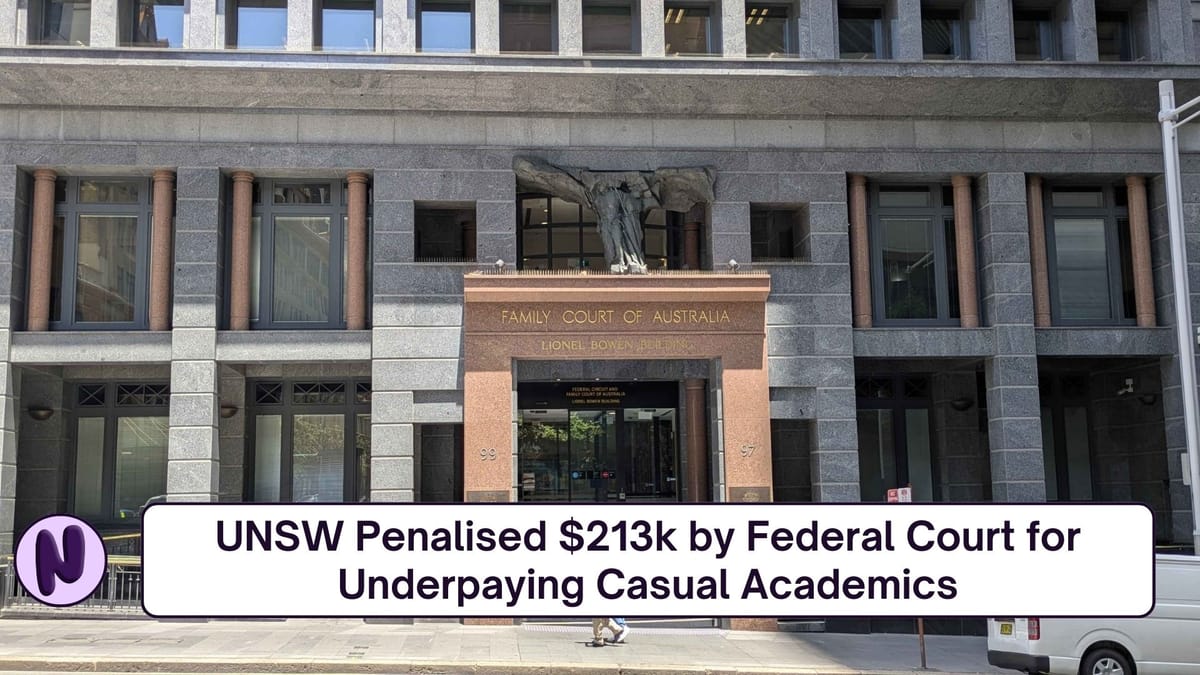
On December 24th 2025, a lengthy legal battle between UNSW and the Fair Work Ombudsman (FWO) came to an end. UNSW was ordered by the Federal Circuit and Family Court of Australia to pay a $213,200 penalty for breaches of the Fair Work Act that occurred between 2017 and 2022.
During that period, UNSW failed to properly record the hours worked by casual academic employees within the UNSW Business School, resulting in underpayment. The failures appear to have caused thousands of hours of unpaid labour, amounting to millions of dollars in unpaid wages.
Judge Brana Obradovic (coincidentally a former UNSW student) presided over the case and found that the university’s failures were “systemic, long-standing and long-lasting.” Specifically, it was noted that senior management became aware of the problems as early as March 2018 but that it “took many years” for a solution to be developed, despite the fact that the adoption of a simple timesheet system would have likely resolved the issue.
UNSW’s breaches of the Fair Work Act occurred due to several failings, mostly arising from not having sufficient systems in place to record the actual hours worked in certain roles. Among other breaches, the university failed to meet its legal requirements to make and keep records of hours worked by employees attending meetings and performing Academic Agreement Duties (such as attending lectures and marking assessments).
The FWO originally became aware of potential problems with UNSW Business School’s recordkeeping in 2018, when they received a complaint from an employee. This led to internal investigations and reviews. The FWO commenced legal proceedings against the university in 2023.
This court case’s purpose was ultimately not to determine whether the breaches had occurred, but rather what civil penalty would have to be paid. UNSW admitted to the contraventions in August of 2024 (9 months after the FWO first commenced proceedings), and has paid over $12,263,611 to the casual academics impacted. Some of the affected parties could not be contacted, and as a result, an additional $1,353,314 remains unpaid.
UNSW has apologised to staff on several occasions since the underpayments were first identified and has adopted a new system to track the hours worked by casual staff.
On January 9th 2026, several weeks after the judgment was handed down, UNSW staff were told in an email that the university “deeply regret[s] these failures of record-keeping and sincerely apologise[s] to everyone who has been affected.” In the same email, it was announced that ‘Program Phoenix’ (the program established by the university to identify and address the underpayments) would be transitioning to “business-as-usual operations”, so “accurate pay, record-keeping and assurance are embedded in everyday practice.”
In recent years, a number of Australian universities have been found by the FWO to have underpaid employees, often by millions of dollars. This includes the University of Sydney, the University of Melbourne, and the University of Technology, Sydney. Judge Obradovic identified this trend as one of the factors considered in the calculation of UNSW’s penalty, saying that “the scale of non-compliance in the tertiary education sector…[highlighted] the need for general deterrence.”
A recent Senate report on the quality of governance at Australian higher education providers identified the underpayment of staff at Australian universities as a widespread issue, with the National Tertiary Education Union estimating Australian university staff could have been underpaid by as much as $400 million.