NUTS' "The Removalists" Review
A thoroughly impressive show that cements itself as the very best that student theatre has to offer.
With most of my midterm worries behind me and a relaxing Flex Week fast approaching, I was particularly excited to continue this publication’s long-standing tradition of reviewing shows by the New South Wales University Theatrical Society (NUTS). I had an inkling of what to expect, as this editor prides himself on doing some background research, and yet I was not prepared for the electric performance awaiting me. From start to finish, I found myself on tenterhooks, paralysed.
Bora Celebi’s vision for David Williamson’s classic Australian play, The Removalists, is nothing short of a triumph. The Removalists is a story set in mid-20th century Melbourne that examines, amongst many other things, how easily we are all capable of violence and chauvinistic disregard for others, but most importantly, how we can, and must, do better. The play is composed of two acts, each taking place in a single scene. In the first, we are introduced to four of the six members of the cast: Constable Ross (Jack Batchelor), his superior officer, Sergeant Simmonds (Edward Joseph), and sisters Kate (Susannah Pretty) and Fiona (Ines S.L.). The second act introduces Fiona’s abusive husband, Kenny (Lola Kate Carlton), as well as the titular removalist (Finn Sargeant).
While I could sit here and recount the entire story, such an act would, frankly, be a disservice to the troupe and the text. I would rather focus on the incredible performances by the cast, Bora Celebi’s direction, and the too-often unsung heroes of the production team. Still, a short summary of the plot is in order. In the first act, Fiona and Kate report Kenny for hitting her. The report is taken by Ross, an officer on his first day, and Simmonds, a jaded and pig-like sergeant. Fiona doesn’t want to press charges, and instead asks for the help of the officers in moving out of her shared apartment. The second act, which comprises the majority of the runtime, follows the officers in getting into altercations with Kenny, who is unexpectedly home on Friday instead of being at the pub, and into altercations with the removalist hired by Fiona, and with Kate. After Kenny is cuffed, and the two sisters leave with the furniture, Ross beats an already-beaten Kenny to death.
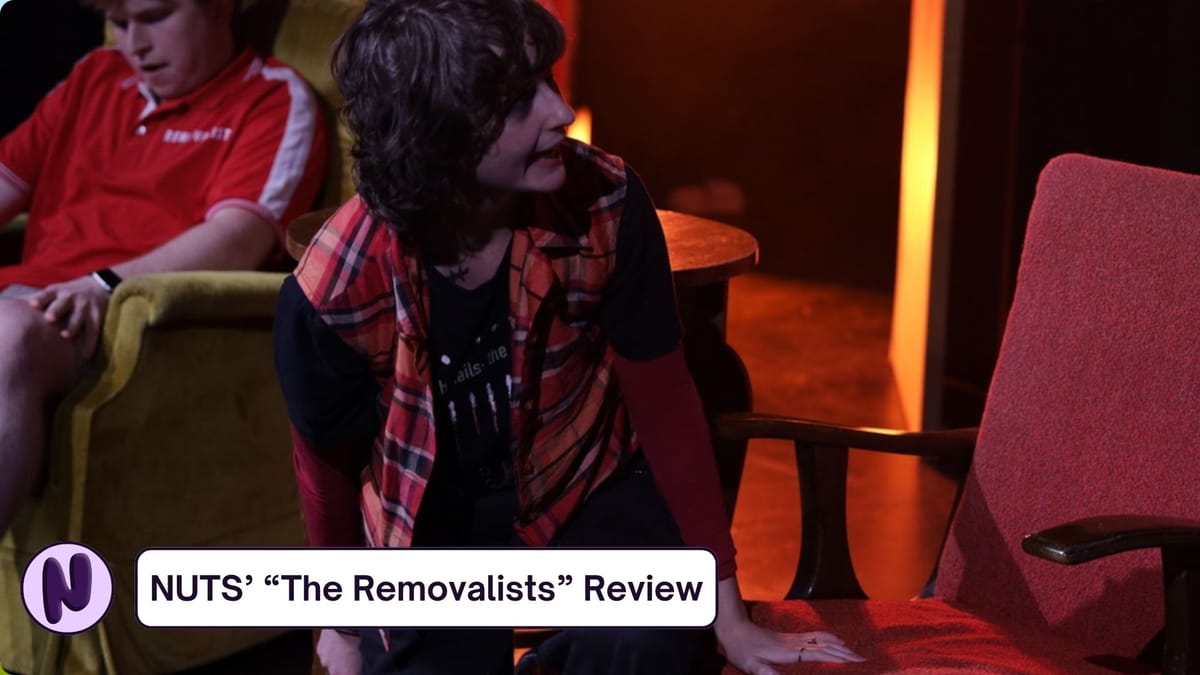
To begin, one of my favourite things about the production behind the show was easily the lighting and stage props. In all the various NUTS shows I have attended, these two components were always a spectacle, but they felt elevated in this play in a way I have never seen before. Given that the moving of furniture is somewhat central to the events of the story, a large assortment of chairs and cabinets were present on stage, and I felt that on a meta-narrative level, the eclectic selection of chairs and sofas gave an insight into the home life of Kenny and Fiona. A home life and household that is a whirlwind, chaotic and messy, but able to present itself as comfortable to the undiscerning observer, much the same way the relationship between an abuser and their victim is so often hidden in plain view. In the same vein, the apartment's red walls created a constant sense of tension and aggression, mirroring the rising conflicts among the cast's strong, belligerent personalities.
Regarding lighting, the creative use of different angles and colours dominated my attention throughout the performance and was second only to the actors on stage. There are far too many comments in my notes detailing different usages, so I will restrain myself to a few examples. After Kenny is cuffed to the front door and all the cast, barring Simmonds, leave, Kenny is brutally beaten by Simmonds for his disgusting sexual comments towards his now ex-wife, and as this takes place, dim red lighting replaces the cool white of the apartment. It’s simple, it’s effective, and it makes you feel a genuine sense of shock, as if you’re watching something you shouldn’t be, rather than the schadenfreude one might expect. Simmonds’ violent antics are interrupted by Kate and Fiona, who appear from the right wings after finishing a private discussion, accompanied by a white glow that creates an almost halo-like silhouette against the dark red backdrop. Later on, as Fiona is dragged away by Kate, Kenny begs Fiona to stay. Fiona stands in the doorway, aglow in a dark red as Kenny grovels, tugging at the hem of her skirt, and in the pregnant pause that follows, it seems as if Fiona is aware that leaving now would indirectly allow for Kenny’s murder. The last example I’d like to mention is moments later, as Ross goes off the deep end and aggressively assaults Kenny while pushing him off-stage, and as this happens, the dark red lighting previously used in violent scenes is instead replaced by a dark blue light which, as it darkens the red walls, evokes the mental imagery of police sirens, which is a scene that is far too often associated with unwarranted police brutality.
Now, about my favourite aspect of the entire show, which is, of course, the highly talented cast. There are many great things I could highlight, such as the incredible restraint shown by Lola Kate Carlton in their portrayal of Kenny, which serves to make the character feel terribly realistic rather than a caricature of an abuser from a parable, but one trait I found myself praising quietly in each of the cast members was just how much they were able to convey about their characters in body language. Edward Joseph is constantly readjusting Simmonds’ smoulder, playing with the scrunch of the eyebrows and mouth, drawing such attention to his facial expression that, even if you were to walk in mid-scene, you would feel the insincerity immediately and know he is not to be trusted. Similarly, Jack Batchelor, who plays Ross, creates these moments with the utmost precision in terms of posture, positioning, and facial expressions, giving us a window into the character’s psyche. Batchelor even displays this talent in moments when Ross is in the background, which really brings a lived-in energy to the performance. The cast have phenomenal chemistry with each other, and none exemplify this more than Susannah Pretty (Kate), whose different yet similarly intense relationships with Fiona and Simmonds command attention like none other. Speaking of which, it would be remiss of me not to mention Ines S.L., who plays Fiona, exemplifying what it means to lead with patience and grace first, and showing utmost restraint in her performance. As a very serious journalist, I have, of course, researched and watched other renditions of The Removalists, and I do believe that no one else has quite lived up to Ines’ performance. The final member of the cast, Finn Sargeant, is, of course, the titular unnamed removalist, and though his acting résumé may be the shortest, that is not something one would ever consider when watching the show. Sargeant shows a mastery of the mix of black comedy and slapstick present in Williamson’s writing that makes me truly excited to see what comes next for him, even if it is moving furniture as an ensemble member in the society’s future production of Hamlet.
Nothing short of brilliant appropriately describes the performance. It is brutal, terribly funny, and devastatingly real.