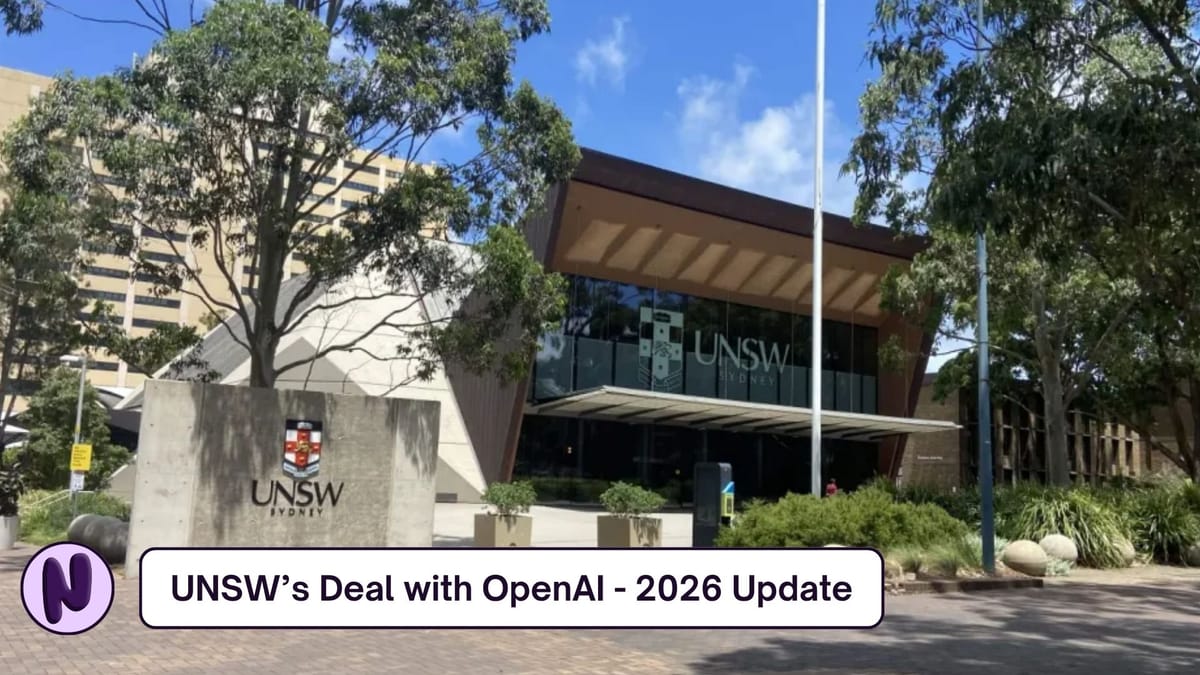
UNSW continues ChatGPT Edu expansion as part of deal with Generative Artificial Intelligence company OpenAI
After completing a ChatGPT Edu pilot program in 2025, UNSW has announced its continued expansion throughout the university.
At the start of 2025, we published an article detailing UNSW’s initial deal with OpenAI, which included a year-long 500-person pilot program across the University that gave select students and staff access to ChatGPT Edu. This version of the Large Language Model (LLM) works like any other but has been specifically designed for universities and claims to have built-in intellectual property protections, meaning that any data entered into it cannot be used to train other AI models. Additionally, ChatGPT Edu lets users build custom GPT-based models and gives universities control over user permissions and data privacy.
10,000 ChatGPT Edu licenses were purchased by the university towards the end of 2025, providing access for all permanent and fixed-term staff. UNSW has recently announced it will be continuing the rollout, extending it to researchers and casual academic staff. UNSW aims to give all students access to ChatGPT Edu by the start of the 2027 academic year, according to an article published last week on the UNSW Newsroom website.
The article also quoted Professor Sarah Maddison, UNSW’s Deputy Vice-Chancellor of Education and Student Experience, who said that “Our ambition is to produce AI-capable graduates. To do that, we need to ensure all students have equitable access to a range of AI tools to help develop their capability and improve their exposure and experience with AI tools. This includes tools that are being used in the industries to which they will likely go into.”
This approach to integrating AI into education is shared by UNSW Vice Chancellor Attila Brungs, who earlier this year told The Australian Financial Review that “AI… actually liberates universities” and that it allows people to “outsource some of the routine grunt [work and] insight gathering,” letting them spend more time learning to think and problem-solve.
One of the key concerns mentioned in last year's Noise article was how UNSW would maintain its commitment to net zero emissions by 2030, given the known environmental impact of emerging AI technologies. In a September 2025 UNSW Newsroom article detailing the initial staff ChatGPT Edu rollout, it was revealed that the University would purchase Australian Carbon Credits as a means to offset emissions associated with the deal.
Carbon credits are credits given to projects that can demonstrate they have stored, reduced, or avoided greenhouse gas emissions. The federal government-run carbon credit scheme offers one credit per tonne of emissions saved. If businesses have put emissions out, they can buy carbon offsets to use an external project’s decarbonisation as a way to ‘offset’ their continued emissions by the same amount.
However, public policy think-tank The Australia Institute says that carbon offsets “at best, only maintain the status quo,” as emissions are in theory just being moved from one sector to another.
This is even more detrimental when the integrity of carbon credits comes into question. UNSW Canberra researcher Megan Evans was part of a team that co-authored a paper published in 2022, blowing the whistle on the failure of the carbon credits scheme. Their research, along with research from the Australia Institute, showed that up to 75% of Australian Carbon Credits do not result in real emissions reductions. If the emissions reductions of those projects aren’t occurring to the degree they claim, or not at all, when those credits are used to offset emissions, there is actually an increase in overall emissions.
The Australia Institute has further explained that carbon credits just delay the inevitable by letting companies sidestep real accountability and change, as “if it’s cheaper and easier to buy carbon credits, companies will invariably take this route rather than actual decarbonisation.”
Since Evans’ paper was published, UNSW has published several articles on the issue, some even written by her and her co-authors. Despite this, they’ve chosen to continue contributing to the scheme.
Noise also received an anonymous tip last week from an attendee of the UNSW all-staff Town Hall on July 2nd, mentioning that, during their brief, Vice Chancellor Attila Brungs and UNSW Sydney Chief Information Officer Dr Chrissy Burns conceded that they know carbon credits have been known to be unreliable and are not enough of a solution, but it's all they can do for now and are discussing further options.
The anonymous staff member, who is also a member of the UNSW branch of the National Tertiary Education Union (NTEU), added that they were “very concerned to see UNSW rushing ahead with implementation of the new LMS’s AI, the OpenAI deal and CoPilot…while admitting that their only current policy to reduce the climate impact of AI was not good enough.” They went on to say, “It seems that UNSW is all steam ahead for AI deals, and they will think about the climate later.”
Noise reached out to the Vice Chancellor’s media team about this matter, but they did not respond to our request for comment.
Another concern is how this change will impact the University's staff more broadly. Thousands of staff at the University of Sydney (USyd) engaged in a strike earlier this month over concerns about how AI would impact their jobs. Just a week later, USyd signed a deal with OpenAI similar to UNSW’s, which was poorly received by the USyd branch of the NTEU.
The UNSW branch of the NTEU’s current Enterprise Bargaining Agreement with the University reached its nominal expiry date in July of this year, and bargaining for a new agreement is still ongoing. Among the NTEU’s ‘Log of Claims’ document, detailing the issues they wish to include in the agreement, is a section asking for “provisions to protect staff against any adverse effects of artificial intelligence systems in the workplace.”
Not all students are on board with this change either.
Third-year UNSW Student Nic recently told The Daily Aus, “I’m quite wary about it, and I don’t know if it’s something they expect everyone to engage with, and I would like the choice to be able to opt out of engaging with it because I don’t see the benefit it would add to my life personally.”
Other interviewees cited academic integrity concerns about how much of what students use ChatGPT Edu for is accessible to UNSW and its teaching staff, as well as the potential for incentivising AI use to reduce students' critical thinking abilities.
As much as many things have changed since we last published about this issue, a lot hasn’t. The many known pitfalls of Generative AI we mentioned last time—its issues with misinformation, bias, discrimination, theft from artists and creators, and its environmental impact—are all still of concern, and it's only getting worse as more research comes out about the detrimental impacts AI is having on people's mental health and cognitive ability, and more and more land is being used to build data centres across the world to keep up with AI’s ever-expanding demand.
UNSW continues to make history with this partnership, but the effects this deal will have on its students, staff, reputation, and environmental promises remain to be seen.