An Introduction to the UNSW SRC and Why it Matters
For this year’s SRC elections, Xavier provides a brief introduction to the UNSW SRC and attempts to remind students why it matters.

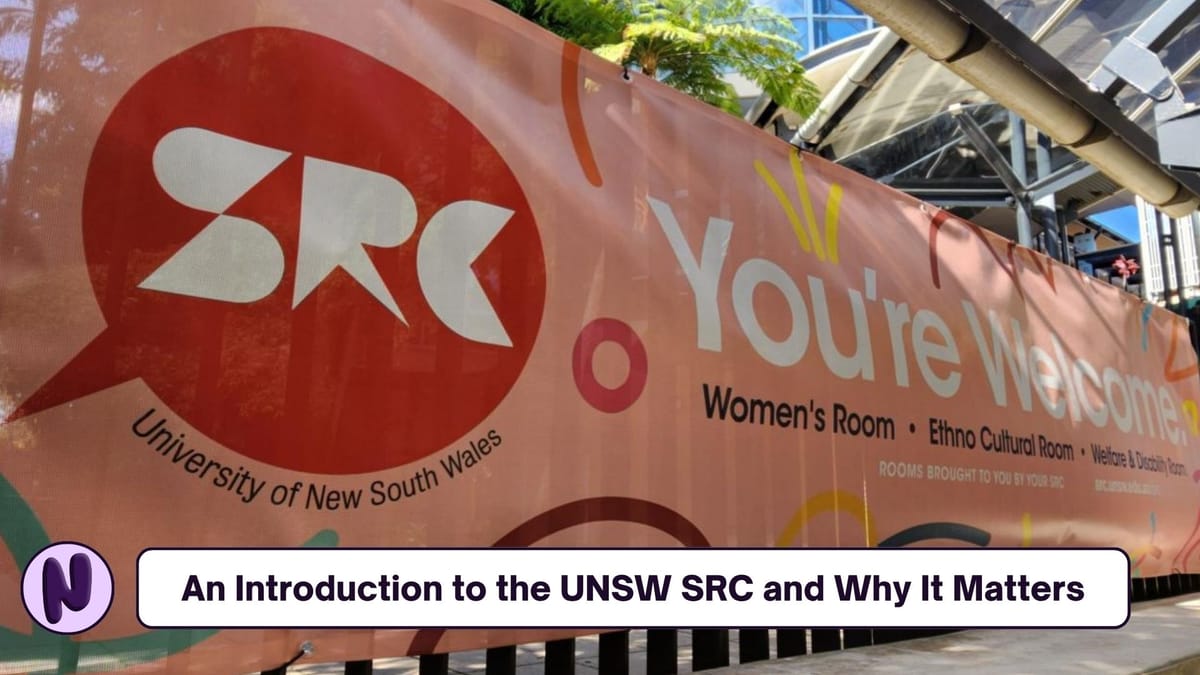
As a UNSW student, you’ve undoubtedly encountered the Student Representative Council (SRC) in some form. Whether it’s a trip to the Queer Space, a clothing swap at Clothes Hub, or, most likely, an interaction with a ticket member on campus, the SRC is constantly working to make life at UNSW better for students. Despite this, many aren’t aware of what the SRC does, or that UNSW has an SRC at all. In this article, you’ll find a quick reference guide to the SRC: who it’s made up of, the major tickets and what it does for you.
What is the SRC?
The SRC is an advocacy body on UNSW campus that represents students in policy changes, maintains and manages collectives and safe spaces, directs students to resources, and implements projects that improve student life.
The SRC comprises the President, the General Secretary, 13 Office Bearers representing 10 collectives, and 12 councillors representing UNSW’s six faculties.
The President is the leader of the SRC and the council’s official spokesperson on various committees and boards at UNSW.
The General Secretary oversees clerical and administrative responsibilities, condensing vast amounts of information for SRC use. The General Secretary's responsibilities include facilitating resource provision to SRC projects, coordinating a central calendar of events and functions, taking meeting minutes, and counting votes at SRC meetings.
Three general office bearers, eight collective office bearers and three Paddington Campus office bearers represent various student collectives in SRC meetings. Office bearers chair and run meetings for their respective collectives, facilitate events, and help maintain their collective spaces. The representatives of the collectives are as follows:
The Education Officer, responsible for promoting fair and equitable access to quality education at UNSW.
The Environment Officer, responsible for campaigning for sustainability and environmental protection at UNSW.
The Welfare Officer, who supports universal student welfare through advocacy and awareness campaigns.
The Ethno-Cultural Officer, who acts as the voice of UNSW’s diverse multicultural student population, including students of colour. They also ensure the SRC recognises and represents students from ethnically diverse backgrounds and advocates for a respectful, racism-free UNSW.
The Indigenous Officer ensures the voice of Indigenous students on campus are represented in the SRC. They advocate for Indigenous students' issues and for a UNSW that acknowledges and represents Indigenous peoples.
The International Students’ Officer represents the vast array of voices from UNSW’s international student population and ensures that international students have equitable representation in SRC initiatives and at UNSW as a whole.
Three Paddington Campus Officers represent domestic and international students who learn at the UNSW Paddington campus. A general representation officer, a domestic students officer, and an international students officer act as the link between UNSW Kensington and UNSW Paddington, ensuring that Paddington students’ voices are equitably represented and that events and initiatives are coordinated with Paddington in mind.
Two Queer Officers represent LGBTQIA+ students at UNSW, ensuring that queer issues are represented on campus and within the SRC. Queer Officer candidates traditionally run as independents (i.e. not on a ticket associated with a political party), and Queer Collective members are the only students allowed to nominate and vote for this position.
The Students with Disabilities Officer acts as the spokesperson for students with disabilities on campus, ensuring they have equitable access to all facets of UNSW life.
The Women’s Officer advocates for all women and gender-diverse people at UNSW and ensures that their issues are represented in the SRC.
Finally, we have the twelve councillors. These students represent two electorates. Electorate A includes students from the Arts, Design and Architecture, Law and Justice, and Business faculties, and Electorate B includes the Engineering, Medicine, and Science faculties. At least four of these councillors, two from each electorate, must be women or gender-diverse people.
What does the SRC do for students?
In the past, the SRC has achieved a laundry list of initiatives and quality of life changes for students, including: flex week in the middle of every term, financial grants for student-run projects, free menstrual products in women’s and unisex bathrooms on campus, the circulation of emergency kits to students, adequate lighting across campus at night time, the Clothes Hub, the implementation of weekly free breakfasts on the Paddington campus and much more.
Beyond these initiatives, the SRC meets monthly (during term time) to pass motions on a wide range of issues. This often involves advocating for a particular movement or political opinion, or debating the best way to approach a problem. These motions can lead to large advocacy events, such as the protest against One Nation Senator Pauline Hanson, which members of the UNSW SRC helped organise.
Where does the SRC fit in with Arc?
The SRC exists as a part of Arc and, just like Arc, is not affiliated with UNSW directly. This means that the SRC receives a small portion of Arc’s Student Services and Amenities Fee (SSAF) allocation.
In 2025, Arc was allocated 40% of the total SSAF collected by UNSW. This totalled $9,118,302. While Arc doesn’t publish the exact percentage of the funds that the SRC receives, it is clear the SRC has at least some budget to fund student initiatives.
Additionally, the SRC President sits on the Arc Board. This allows the SRC President to give feedback on Arc’s direction and services directly to the Arc CEO (Shelley Valentine) and her team. This means the SRC has the ability to influence changes in aspects of non-academic student life, including clubs, Arc sport, volunteering and Arc’s legal, financial and health services.
Who are the major tickets in the SRC?
Currently—and going into this year's election—there are four major tickets on the UNSW SRC: Left Action, Together, Kensington Fried Chicken (KFC) and Grassroots.
In addition, there are a number of minor tickets and independent candidates running in this election.
Here’s some more information about the major tickets:
Grassroots: Formerly 365 for SRC and SHOUTOUT!, these two tickets merged to create one unified ticket. Self-described as “staunch activists,” “student advocates,” “dedicated leftists,” and “organisers.” Grassroots don’t align themselves with a major Australian political party; however, they do accept members of left-wing parties such as the Greens and NSW Socialists. Grassroots are campaigning in 2026 with goals such as “a moratorium on UNSW’s partnership with OpenAI, affordable student housing on campus, cut[ting] ties with weapons companies, reduced cap[s] on assessment weighting (60% → 40%), free textbooks/resources hub,” and a number of other issues, available for the voter to view on their Instagram.
Kensington Fried Chicken (KFC): KFC is considered a Liberal-leaning ticket as many of their members are part of UNSW’s Liberal club. KFC are campaigning in 2026 for “disaffiliation with the National Union of Students (NUS), the removal of high school students from the UNSW library, digital student IDs” and, of course, to “push and advocate for fried chicken on campus.” The full list of KFC policies is available for the voter to view on their Instagram, where they have also been posting some incredibly zany, mostly AI-generated content leading up to the election.
Left Action: Left Action is one of the largest tickets on campus and describes themselves as “socialist activists.” Left Action is campaigning in 2026 with goals such as “free education, $100 rent caps, free canteens, free Palestine” and several other issues. Left Action is strongly associated with the Socialist Alternative political organisation. Voters can view a list of their policies on their Instagram.
Together: Together is a coalition ticket comprised of Unity (Labor Right) members and National Labor Students (NLS) members (Labor Left); however, this was not the case last year, as Together was solely a Unity ticket and NLS members ran with the since-defunct ticket SHOUTOUT!. Together is campaigning for “cheaper transport, free textbooks, free post-exam drinks, cheaper parking,” and several other goals, as shown on their Instagram.
Why should I care?
The SRC is the primary advocacy body for UNSW students. Through democratic elections, UNSW students can elect representatives to campaign on the issues that matter to them. Additionally, the President of the SRC sits on UNSW governance bodies at all levels, including the Academic Board (the same board as the Vice-Chancellor). As UNSW continues to change, students need a body whose sole purpose is to advocate for and represent the issues they find important.
Without the SRC, the lives of UNSW students would undoubtedly be worse. A world without the SRC is one where UNSW management has complete control of the student population. So while it may be frustrating to be accosted by politicians and protesters on your way to class, remember that without the SRC, UNSW life would be significantly harder. Through advocacy, the SRC provides students with many privileges that are often taken for granted. This election, ensure that you vote to continue supporting the voice that supports you.
When can I vote in 2026?
Voting will open at 7 am on Monday the 26th of October, 2026 (Monday of Week 7) and conclude at 9 pm on Thursday the 29th of October, 2026 (Thursday of Week 7). All UNSW students on Kensington, Paddington and Canberra campuses are eligible to vote. UNSW College students are associate members of Arc and are therefore not eligible to vote.
On Monday the 26th of October, eligible students will receive an email to their university email address containing their voting link. Voting is online only.
If you don’t receive a link to vote, check your spam. If you have other issues with the voting form, or can’t find the link in your spam folder, contact Phillip Binns (SRC Returning Officer) via [email protected].