SpArc is Dead
Arc Membership Portal to be replaced by the end of the year.
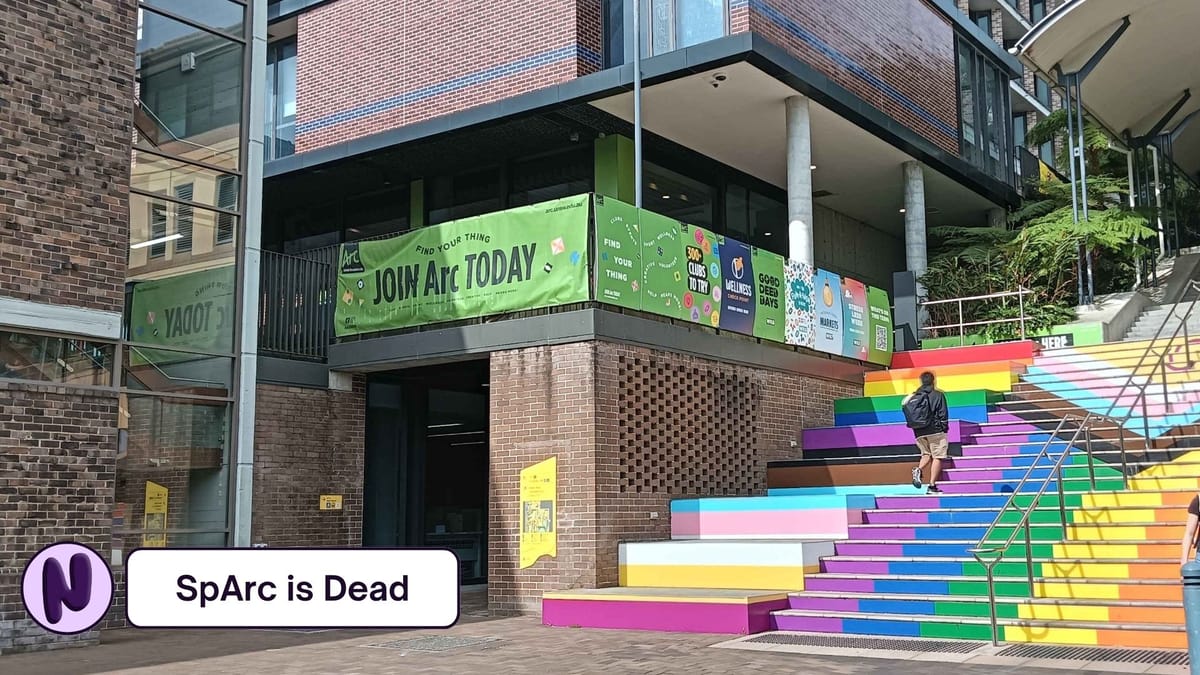
A surprise announcement was made by Arc Clubs last week on Thursday, the 24th of July, with the news that the Arc Membership Portal, formerly known (and still commonly referred to) as SpArc, will be replaced in the coming months.
SpArc, in its current form, is for most students simply the place where they sign up to the “formal” membership list for Arc-affiliated clubs and societies at UNSW. More importantly for the executives of these clubs, however, it is the system used to submit documentation to Arc for processing, review, and approval. This includes grant applications, minutes of general meetings, and the current executive structure.
SpArc is powered by multinational CRM software developer Salesforce, which has been in use since 2019. It will be replaced by a system powered by Rubric, a system that started in 2017, primarily designed to be used by universities and university organisations. It claims to have “developed a solution to significantly reduce the administrative workload of clubs.”
Rubric-powered systems are currently used by student body organisations at over 100 universities worldwide, at least 10 of which are in Australia, including ANU, the University of Newcastle, and the University of Queensland. That being said, a good number of these only switched over in the past year.
The decision to change the system and select Rubric was made at an Arc Board meeting held on the 26th of March 2025. Publicly published minutes for the meeting state that points identified by the Technology Committee at Arc were “raised… and clarified” with Rubric.
The announcements frequently highlight the advantages of using Rubric instead of SpArc, the latter regularly being the subject of ire and ridicule, likely one of the key reasons behind the switch.
The most significant change is that accounts for the new system will be accessed by logging in using the UNSW Single Sign-On (SSO); that is, your generic UNSW student account, similar to accessing myUNSW or Moodle.
Under the current system, it is up to the individual which email account they sign up with, be it their personal email or their student one. This frequently leads to confusion, especially among new students at T1 O-Week, about how to sign up for SpArc and/or remembering with which email (or password) they have signed up.
Arc Clubs in their announcement have stated that all accounts and membership lists will be transferred to the new system automatically, and as such, have strongly requested that people “DO NOT CREATE A NEW ACCOUNT” for either the Club or their personal account if they do not already have one, as doing so may delay or disrupt the handover. Arc Clubs has confirmed that this will still work for non-UNSW students.
Other quality-of-life improvements for regular clubs members are the implementation of club membership status into digital wallets, such as Apple Pay or Google Wallet, negating the need to check or remember if or what clubs they are signed up to on SpArc, the information of which is a required field when filling out the attendance list for an event. Direct implementation of ticket and merchandise sales is also a touted feature, allowing a greater utilisation amongst general club members in addition to being preferable to alternative methods of payment, such as direct bank transfer.
By far the most impactful changes will be the benefits of club executives, particularly those who need to use SpArc as part of their responsibilities. Most significant is the news that the number of allocatable admin positions (that is able to perform executive functions) available per club is unlimited and variable according to a club's needs. This allows the opportunity to spread out the workload to different members if so desired, providing a marked contrast to the current system.
This point was most clearly brought to light at the start of 2025 after the decision was made to reduce the number of SpArc admins per club from two to one, after running out of allocatable admin positions (without paying for more), given the large number of new clubs that registered in the previous year.
Whilst most clubs can get by with all SpArc functions being performed by one member, this brought major concern about the vulnerability of not having a backup in case the dedicated admin user could not perform their roles for whatever reason.
Other benefits include an in-built email and SMS sender to the whole club membership list, a marked improvement for sending out notice of General Meetings as per requirements, which currently involves exporting the whole membership list into a spreadsheet and copy-pasting the emails in. Arc Clubs has confirmed that more details and features will be announced in due course.
The changeover will start to take place within the next couple of months, starting with the migration of club membership lists in early-mid September. SpArc will then be phased out from mid-October, with full Clubs features such as event ticketing to be implemented at the start of 2026. This notably runs close to the clubs reaffiliation period, which will run between 15th September and 12th October. This is the period where all clubs are required to submit documentation to Arc to remain as an affiliated club for the following year, with most clubs holding their Annual General Meetings at this time. This process requires submitting lots of documentation within concrete timeframes, including minutes of the AGM, notifying of the elected executive for the coming year, the revised Club constitution (if necessary), allocation of new bank signatories, and both a president’s report and a treasurer’s report. Crucially for Clubs Executive, reaffiliation documentation will be submitted via Rubric, and not on SpArc, which may present a problem if any teething issues occur.
Whilst much is still unknown about how the specific operations of the new system will materialise, it is certain to be a major shake-up with how a UNSW club and its executive team interact with both its members and with Arc Clubs.
Watch this space.