From the Bisalloy Picket Line
When does a weapon become a weapon? Is it when steel begins to take the shape of a blade, a gun, a tank, or a jet? Is it when a bullet is filled with gunpowder, when the primer is set, or when the bullets are loaded into a magazine? Is a weapon a weapon if it has no ammunition?
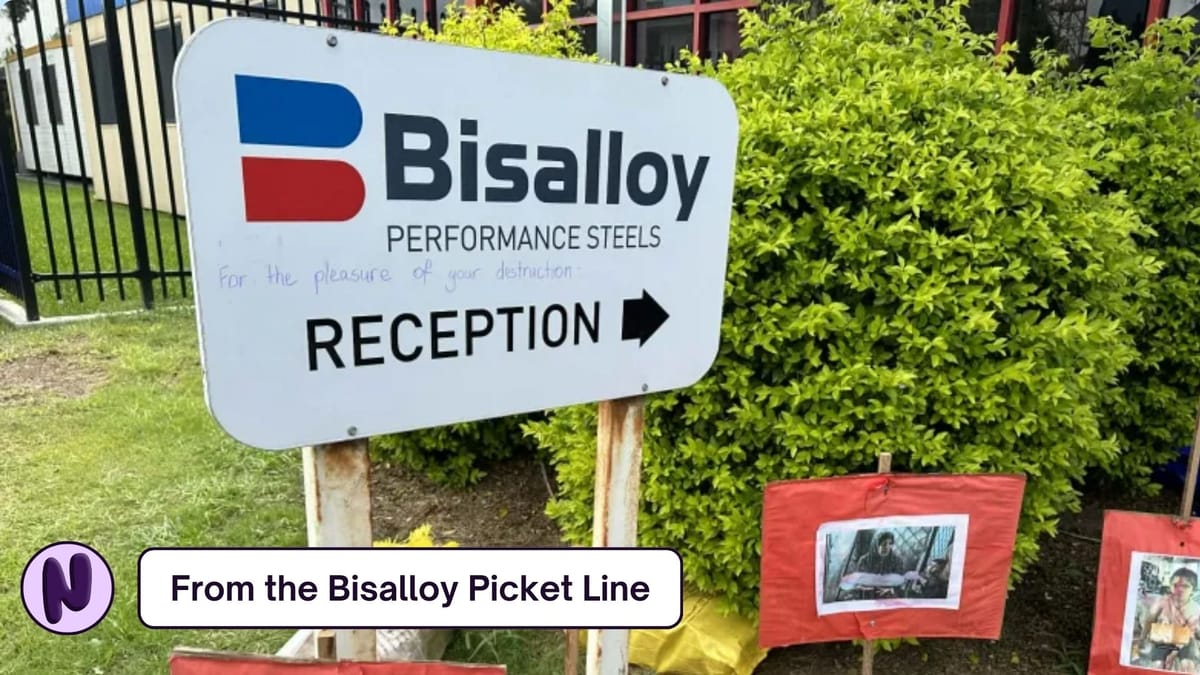
Bisalloy Steels, a steel manufacturer in Unanderra, states they’re “Australia’s only manufacturer of high-tensile and abrasion-resistant quenched and tempered steel plate[s].” They love to flaunt their partnership with Rafael Advanced Defense Systems, and have been supplying them with steel for 20 years. They also claim that the quantities of steel plates that they produce can not possibly be enough to make the weapons that Rafael produces, so I guess they’re proud of failing to meet the demands of their warmongering contractors.
Minister for Foreign Affairs, Penny Wong, would have us believe that Australia only supplies “non-lethal” parts to Israel for maintenance of its F-35 fighter jets. These “non-lethal” parts include flight control systems and engine components, which makes you wonder, if these parts are truly “non-lethal”, then perhaps the fighter jets can fly just fine without our business. It seems our parts are essential enough for their ability to taxi, fly over, and bomb Palestinian homes, so maybe we can cut our complicity in the genocide by breaking the supply chain.
Wollongong Friends of Palestine have drawn the line of what they consider to be a weapon, and that line is at Bisalloy Steels in Unanderra. From the 8th to the 10th of February, they set up camp and held a picket line, preventing workers from entering the steel manufacturer that continues to supply the genocide in Palestine.
The first night of the picket was a quick and easy success. Activists managed to cancel the first overnight shift with little resistance. Workers did not show up, and security personnel were rotated in and out. Cops stood off to the side, watching with their hands on their holsters and their eyes trained on each and every new picketer settling in. Their holsters held a weapon, a Glock .40 semi-automatic pistol.
A picket line is not a weapon. A picket line is made up of people and obstacles whose sole purpose is to stop the production of weapons. The people of Wollongong Friends of Palestine expressed a single sentiment, that locals would have no part in exporting the means of war to foreign powers.
It is the same sentiment that Lee Rhiannon shared with the 1983 Pine Gap Women’s Peace Camp, opposing our government’s complicity in supporting fascist foreign powers. A United States military base on Australian soil, aimed at spying on our East Asian and Middle Eastern neighbours. A base full of soldiers with diplomatic immunity, allowed to do whatever they please. One hundred and eleven women marched into that military base to document and disrupt its operations. That march was led by local Indigenous women who had no say in this foreign power setting up their own colony within the colony of Australia.
“The armaments industry is so terrible, it’s terrible because it kills so many people and causes such suffering,” Ms Rhiannon shared with me on a phone call, after I had met her at the recent Unanderra picket.
“It’s also so terrible because it robs people, robs the public of money that’s needed for public education, public health, and public services.”
The duration of the picket coincided with the irreverent arrival of Israel’s president, Isaac Herzog. His arrival came at a time when Chris Minns’ government was infringing on the right to protest, banning organised marches and slogans like “globalise the intifada.”
A contingent of picketers (including myself) took a bus up to Sydney to join the rally, where we were faced with a heavy police presence that had already surrounded Town Hall. They had sectioned off all sides of the courtyard except for one, where protesters were herded until all sides were closed off. From there, people wanting to join the rally had to wait outside the courtyard until NSW Police finally relented and let them through.
When speeches for the rally finished, Superintendent Paul Dunstan gave orders to organisers to disperse the crowd, which was a little difficult when his officers had blocked off every exit.
I made my way to the frontline where protestors were face-to-face with police when I saw an Indigenous activist push through the crowd after being pepper-sprayed. Once again, it was Indigenous people at the forefront, against the state, against injustice, and against weapons. And then, I was face-to-face with a weapon.
My eyes and throat burned as I choked, and I was pushing back through the crowd. I was lucky to find myself amongst friends, who took care of me and washed out all the capsaicin from my eyes with saline. Not long after recovering, though, we were being herded and pushed along the light rail line towards Central. Inadvertently, the police had begun pushing the crowd into a march.
Earlier, there were whispers that police were holding on to and hoping to use a Long-Range Acoustic Device (LRAD). It had been known for a while that NSW Police finally got their hands on one, but had had no opportunity to use it. When we reached Central Station, we heard a warning tone coming from it, and the crowd ran to all different sides to avoid the narrow range of the LRAD. Any exposure to an LRAD’s sound can cause permanent hearing damage, and so that begs the question: Is a loudspeaker that aims to blow up people’s eardrums a weapon?
Back down at the picket, police presence had eased to just two cops watching from a distance, though they were dressed in the same riot gear that the cops at the Herzog rally were in. Body armour and extra weapons in defence of what?
The final day of the picket was solemn, with news coming in of police brutality at the rally against Herzog, though there was still pride and hope. The picket had successfully prevented Bisalloy workers from working shifts over its three-day period, and people began to pack up. Of course, there was a sentiment to keep the picket going, but with dwindling numbers, it couldn’t hold strong. Despite that, this is the longest picket Wollongong Friends of Palestine have been able to hold.
In the wake of all this, though, a snap rally was held outside Surry Hills police station on the 10th of February. Although much smaller in numbers, activists called the state and its police into question. Speakers questioned the abuse of Muslim men and women who were praying the Maghrib at sundown, in accordance with their faith. They questioned the abuse perpetuated by police, with violence, pepper spray, and the threatening presence of the LRAD. Most of all, they questioned why all of this was done in the service of a foreign power.
In the face of state oppression, the weapons industry, and our government’s continued complicity with fascist foreign powers since Pine Gap, I was reminded of Lee Rhiannon’s words at the picket.
“This isn’t just about Palestine, it’s [about] how we build a world where justice, equality, and peace is the foundation of our society.”