Arc Votes to Tighten Rules on Member Petitions for General Meetings

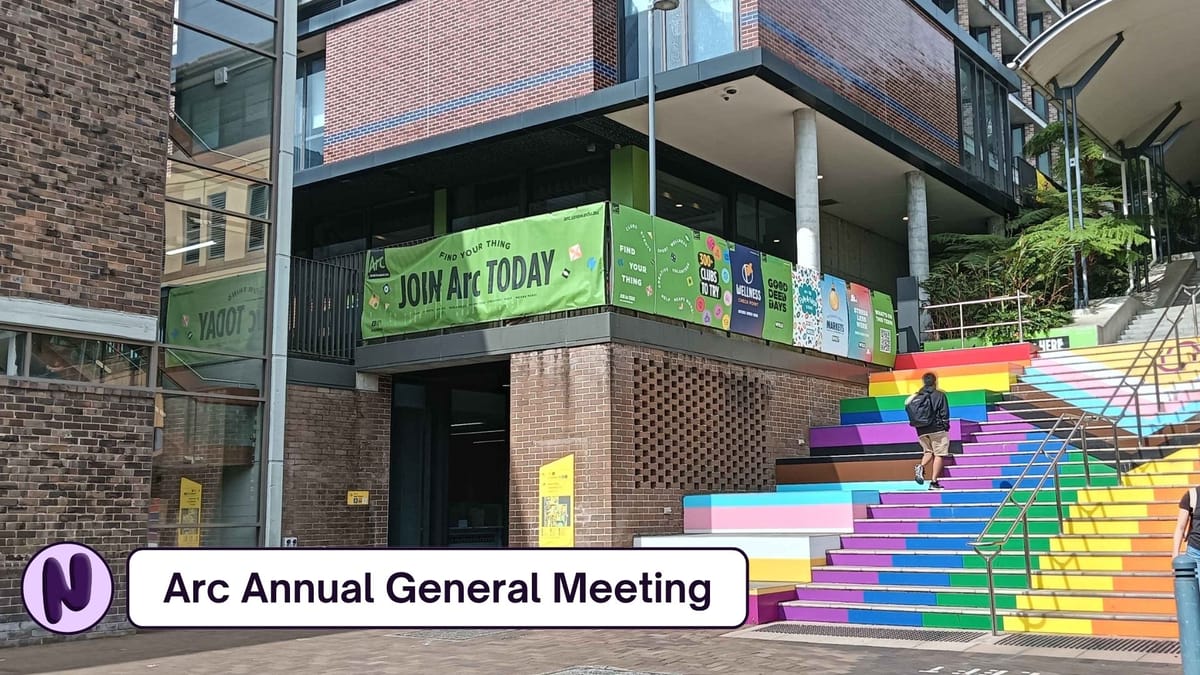
Last Wednesday, Arc held its Annual General Meeting (AGM).
The AGM is a yearly meeting that companies are required to hold to meet their reporting requirements to government bodies. The usual purpose of the AGM is for Arc to approve its report on the organisation for the past financial year. The motion to confirm the report, alongside previous minutes, was carried uncontroversially. All motions proposed during the meeting, including the reports, can be viewed on Arc’s website here: https://www.arc.unsw.edu.au/about/annual-general-meeting-agm-2025?mc_cid=fbb630d9e6&mc_eid=41b3da46ca
Also proposed at the AGM were three amendments to Arc’s constitution. At the start of the meeting, the Chair announced that he held over 200 proxies, meaning that these motions could go ahead. In addition to the normal quorum of 50, a quorum of 200 is required to pass constitutional changes, also requiring an additional threshold of a 75% majority.
The first proposed amendment would increase the number of people required to petition a general meeting from 50 to 500, a significant increase. The Chair of the Board justified these changes, stating that it was warranted based on the increase in membership since Arc was founded. He emphasised that there were other ways to provide feedback to Arc and have them make changes without calling a general meeting, noting that this would be a waste of Arc’s resources.
Three individuals spoke in the discussion portion of the meeting. Two of the speakers, representatives from UNSW’s SRC, raised points about how the change was not reflective of other nearby Go8 universities, namely USYD and ANU, and claimed that the change was clearly reactionary towards previous general meetings like the Boycott, Divestment, Sanctions EGM last year, which successfully increased Arc’s investment transparency. The SRC had passed a motion opposing the constitutional change at their meeting earlier that week. Other important general meetings have used this mechanism to force Arc to divest from weapons manufacturers, implement gender based equality in the Arc board,as well as better implement gender diverse people. A representative from the board spoke for the resolution, echoing points the Chair had made.
Following the discussion, the motion passed. The vote counts have not been made public at this stage.
The second proposed amendment sought to alter how proxy voting works, so that only the chair of the board could hold multiple proxy votes. The Chair spoke about how this motion did not intend to suppress voting and stated it was primarily administrative, as the chair is obliged to vote in accordance with whatever the proxy states, regardless. During the discussion, it was raised by members opposing the motion that proxies would be better held in the hands of people whom members trusted. This motion also passed.
The final motion proposed to clarify the rules under which a Director of the Board could be removed, which passed uncontroversially. The meeting subsequently wrapped up, much earlier than anticipated.
Going forward, it will now be more difficult for students who wish to organise a general meeting. Whether this change has any long-term impact on student activism and Arc’s engagement with its members, time will tell.