Private School Lobby Pushes for Increased Funding As the Federal Election Kicks Off
As the federal election heats up, Marcus unpacks a lobby group's attempts to put private education centre stage.
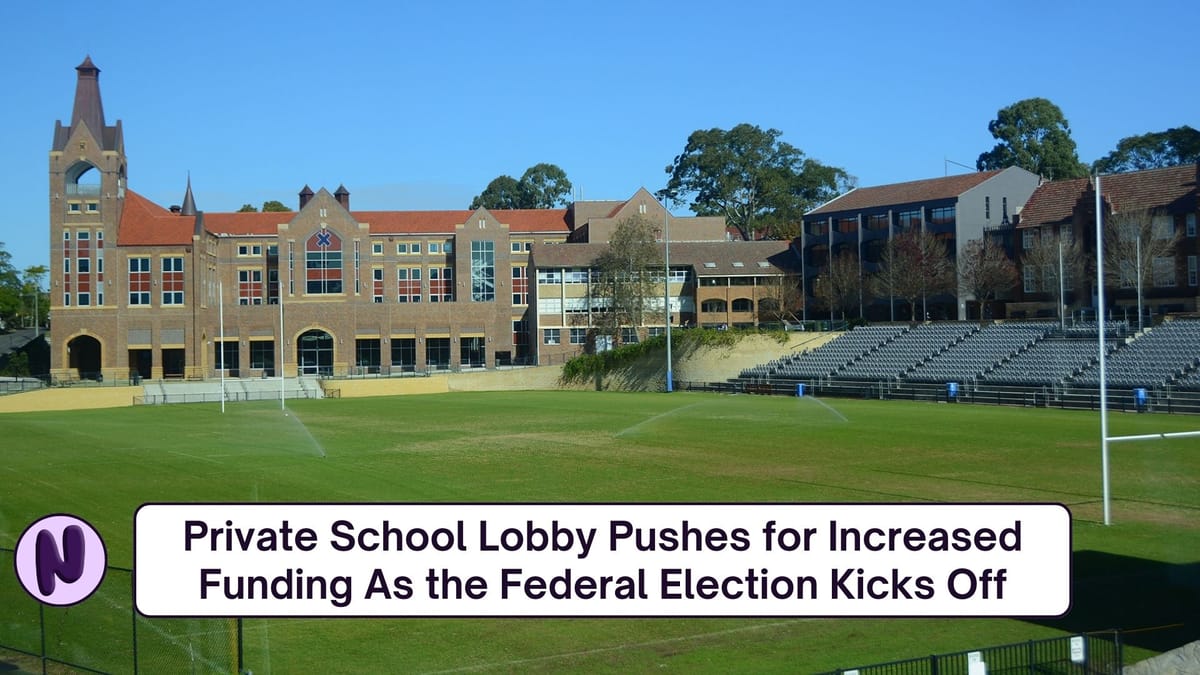
Independent Schools Australia (ISA), the country’s peak private school advocacy group, has launched a national campaign as the 2025 Australian election season begins in full. The campaign, titled ‘School Choice Counts’ is attempting to convince parents to vote for politicians that would protect private schools from funding cuts, end “the blame game” they believe private schools are subjected to, and help secure a $50 million innovation fund.
The campaign will target 17 federal seats across the country – primarily those held by Labor MPs and Teal independents. All four seats held by the Greens, who have repeatedly criticised government funding of private schools, are also in the crosshairs. Three seats held by the Coalition will also be targeted.
Arguing for the necessity of the campaign, ISA CEO Graham Catt said in a media release that “no family should be punished for making the best choice for their child’s education.”
Enrollments in private schools have risen dramatically over recent years. According to data from the Australian Bureau of Statistics (ABS), while the number of students enrolled in public schools increased by only 0.2 percent from 2023-2024, enrollment in non-government schools increased by 2.7 percent. In some states, including New South Wales, enrollment in public schools has actually gone backwards.
Several factors are likely influencing this shift in the nation’s education landscape. There’s a perception held by many that private schools provide a higher quality of education, and lead to improved academic performance. However, this doesn’t seem to actually be the case.
A study in the Australian Education Researcher found that although “already higher achieving students are more likely to attend private schools,” private school attendance itself “does not alter academic trajectories.” The real factors impacting academic performance in Australia appear to be socio-economic status and geographic location.

Another reason parents may prefer private education is that a number of non-government schools have a religious affiliation, which can make them more appealing to religious families. Catholic schools alone make up over 18% of the nation’s schools.
And then, of course, there's the issue of funding.
In Australia, public schools are funded almost entirely by government money – mostly from the government of the state or territory the school is located in, with some additional funding from the federal government. Private schools, by contrast, typically receive little money from states and territories, but get more from the Commonwealth than public schools do ($15.4 billion in recurrent costs in 2021). In addition to this, private schools typically charge significant fees to parents. According to ISA, the median annual fee for attending a private school is $5,537.
This is important, especially when it’s considered that under the Schools Resource Standard (SRS) – devised by UNSW Chancellor David Gonski in the 2011 Gonski Report – 98% of public schools are currently underfunded. Private schools, by contrast, are often overfunded. A small number of schools that charge parents over $40,000 per annum still receive additional federal government funding.
Correna Haythorpe, the Federal President of the Australian Education Union (AEU), stated in a press release that “public schools are lagging behind both in recurrent income per student and in money spent on school infrastructure, creating deep inequity and a two-tiered system.”
Though it may easily have been lost in the slurry of election headlines, Queensland and New South Wales recently became the final states to sign an agreement with the federal government, which will see public schools finally reach full funding over the next decade. This is excellent news for Australian education in the long term. But in the immediate, with the clear funding disparity between the public and private sectors, it's understandable why many parents would choose to send their children into private education.
Haythorpe has accused opposition leader Peter Dutton of failing to guarantee he will keep the current agreements if elected, saying that “with an imminent federal election, there must be bi-partisan support for full funding of public schools.”
The SRS bases its recommended funding levels off of student numbers at individual schools, with other needs-based factors also being taken into consideration. As public schools continue to lose students to their private counterparts, it creates a risk that public school funding and quality will further decline.
It should also be noted that Australia’s private school system is not the norm. Of the 38 countries in the OECD, Australia has the fourth most privatised school system. For example, Finland, the highest ranked country for education in the OECD, has very few private schools, and those that do exist receive the same level of government funding as public schools and cannot charge student fees.