New AI Art Course Garners Heavy Criticism
Eugene and Robin dissect UNSW’s new controversial AI art course.
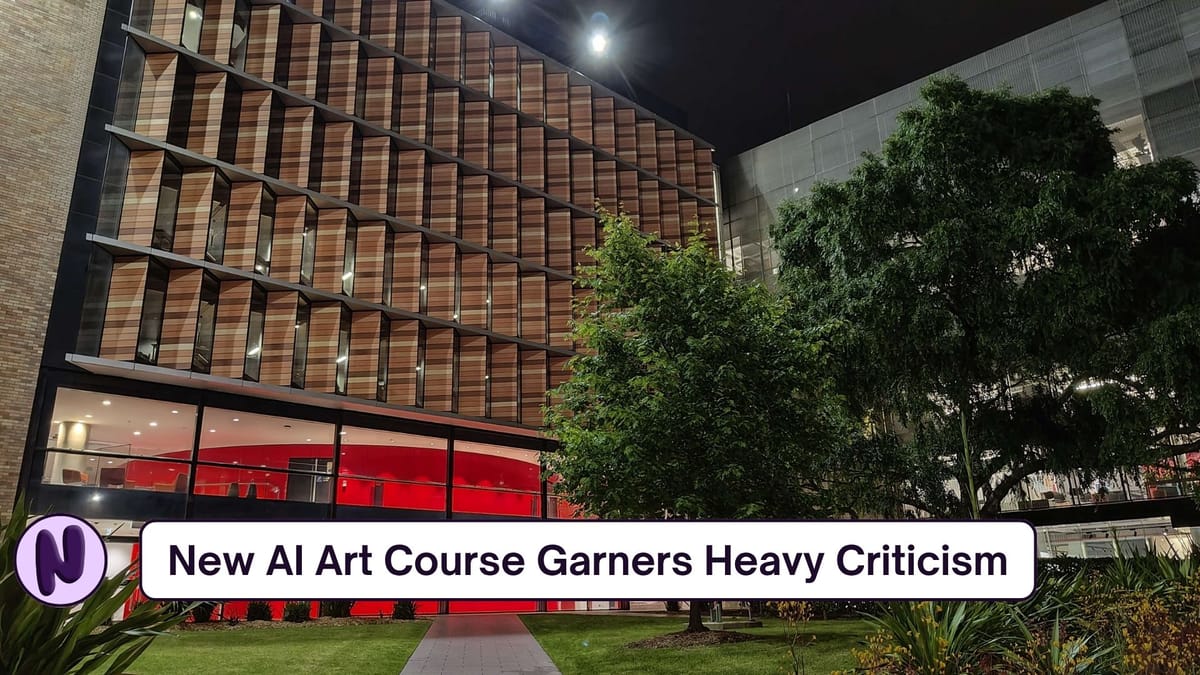
A petition by a UNSW Fine Arts student has amassed over 5,000 signatures within less than two weeks, garnering coverage by multiple large news outlets and resulting in statements from UNSW. It all surrounds a (partially) new course by the name of ‘Generative AI for Artists’, which has sparked outrage among artists, hobbyists and the general population. Commenters find it ‘astonishing’, ‘insulting’, ‘frustrating’, and ‘redundant’, and UNSW’s Student Representative Council has called for the course to be stopped. Meanwhile, UNSW stands steadfast in its assertion that the course is justified – but what are the students’ arguments?
Artificial intelligence has been around for decades, but the form dominating the current discussion is different. ‘Generative AI’, sometimes abbreviated to ‘gen AI’, analyses databases of media to find patterns and uses them to procedurally generate imitations. As a result of the complexity of human-generated text and images, these databases need to be massive in order to produce an acceptable quality output, and so are often ‘scraped’ from the internet without many filters. Each piece of media must be labelled with descriptive terms so that the AI understands what it is. Then, the patterns between similar media are analysed and replicated in data centres – locations which contain up to 32,000 GPUs to account for the high processing power. It is this method that creates the issues seen with generative AI, such as:
- AI has increased its global energy consumption by 12% per year over the past 5 years according to the International Energy Agency and MIT.
- Humans need to label the data being fed in. In practice, the conditions these workers have been subjected to have been compared to modern slave labour.
- As AI collects large amounts of data and generates information/images, there are moral and legal issues related to intellectual property, plagiarism, malicious use, and job displacement. Artists feel threatened by the disrespect towards their work.
- Due to the algorithmic process of generative AI, it typically leans towards cliches and stereotypes. Not only does this significantly decrease the originality of the work, but it can also reinforce existing narratives, such as those about marginalised populations.
This brings us back to the petition. It concerns DART2252, which was renamed in 2025 to ‘Generative AI for Artists’. At this stage it is difficult to know what exactly will be in it as there has not been a course outline published yet, but what we do know comes from the overview, which focuses on, “introducing you to key concepts, skills, and methods for engaging critically and creatively with generative AI,” and mentions “project-based learning”. From this, we can assume that the course takes both a theoretical and practical approach to learning; in other words, students learn about generative AI both through instruction and through using it themselves.
It is this practical application that many have a problem with. Studying the ethical concerns of generative AI is important for the next generation of artists given its astounding and rising prominence, but requiring the use of it assumes that any benefits in this context outweigh the immense cost. As evidenced by the enormous support our petition has received, a large portion of the UNSW student body thinks otherwise.
With this said, UNSW’s relationship with AI extends far beyond a single subject. DART2252 is actually one of the more positive examples: the course convenor, Oliver Bown, has expressed enthusiastic interest in student input to help make the subject’s use of generative AI more ethical. He has been in discussion with the petition’s creator to do just that. However, it seems that other (or perhaps most) places within the university are not treating the subject with the same sensitivity. UNSW has recently entered a collaborative relationship with OpenAI, creators of ChatGPT, and has even created the UNSW AI Institute. These massive, rapid changes are highly concerning to many students given the immense ethical concerns previously outlined.
Alongside this issue, one of the proposed methods to keep gen AI more ethical is to create an “in-house image generator”. However, it is believed that this would not truly circumvent the issues raised by the students. Ren Woodward, a digital artist who is also studying AI as a part of their thesis, says that whilst UNSW does have resources to create a less energy-intensive model, the biggest problem lies in collating images ethically. The amount of properly licensed art/images to train an AI model would require a lot of time and money overall.
It is why AI companies do not do this, as it is “cheaper, faster and easier to steal and deal with the repercussions later”, according to Woodward. Even if there’s a model made specifically for DART2252, Woodward does not believe that AI will be used for artistic purposes, but with the intent to replace humans.
“These models almost always have the goal to replace humans, for companies to pay fewer people for their labour, not to advance science.” - Ren Woodward
Despite the massive effort to get information about DART2252’s creation, there are currently more questions than answers, not least from the thousands of voices that signed the petition. If the course is intended to be more critical and investigative about gen-AI usage, why is the current course description so vaguely concerning its stance? What is the purpose of combating AI’s capitalist rise by using gen-AI? Is there a way of creating or altering an AI model that poses an acceptable risk in terms of energy efficiency, handling misuse, and intellectual property? Why let students spend a thousand dollars to spend ten weeks on the ethics of AI when information about its detrimental effects is easily available online? And finally, is it truly worth sacrificing the environment and thousands of anonymous pen strokes to generate an image that stands without community and expression?
As the future of the course and how art students may be treated is highly uncertain, we are more determined to give UNSW students updates whenever possible.
“There is also a longer term existential threat that will arise when we create digital beings that are more intelligent than ourselves. We have no idea whether we can stay in control. But we now have evidence that if they are created by companies motivated by short-term profits, our safety will not be the top priority.”
- Geoffrey Hinton’s 2024 Nobel Prize Speech