Justice for Cassius Turvey
Riya looks back on NAIDOC week and honours a young Indigenous boy, taken too soon.
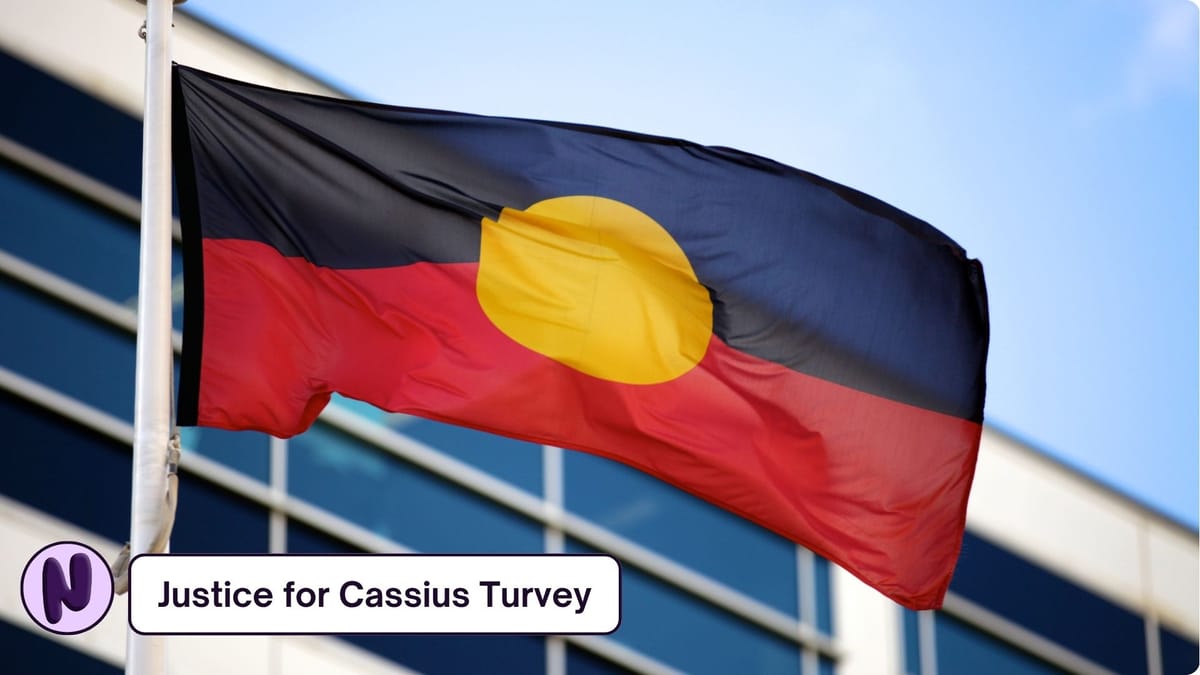
At the 50th Annual National Aboriginal and Islanders Day Observance Committee (NAIDOC) awards ceremony, Blak excellence and leadership were powerfully embodied in the achievements of the ten award recipients. The NAIDOC movement, which began as a national protest in 1938, has since evolved into a week-long celebration of Aboriginal and Torres Strait Islander history, culture, and resistance. It continues to serve as a vital platform for truth-telling, learning, and reconciliation.
The theme of this year’s event, held during early July in 2025, ‘The Next Generation: Strength, Vision and Legacy’, asks individuals to consider the power of the young Aboriginal community, who are still experiencing disproportionate rates of systemic racism in Australia. Narelda Jacobs OAM, a Whadjuk Noongar woman and journalist, reiterated this ongoing issue as she presented this year’s awards ceremony. In her speech, she paid tribute to Mechelle Turvey, mother of Cassius Turvey, calling her a “wonderful and treasured Noongar woman” experiencing “unspeakable grief” after the death of her son in late 2022.
At the end of June, the Western Australian Supreme Court delivered sentences to those involved in the assault of 15-year-old Cassius Turvey, a proud Noongar-Yamatji boy. Two men were found guilty of murder and sentenced to life imprisonment, while a third man was convicted of manslaughter and sentenced to 12 years. A fourth woman who was with the group was acquitted of Cassius’s murder, but received a suspended 15-month sentence for abducting other teenagers.
On October 13th, 2022, while walking home from school in his uniform with friends in a quiet Perth suburb, Cassius was approached by a ute whose occupants hurled verbal abuse. One of the men exited the vehicle and chased the boys, ultimately assaulting Cassius with a metal pole. He sustained severe head injuries, including brain bleeds and lacerations. Though discharged from hospital five days later, he suffered a seizure shortly after and required emergency brain surgery. Cassius was placed in an induced coma and tragically passed away ten days after the attack.
In the days that followed, WA Police Commissioner Col Blanch suggested the homicide may have been a case of mistaken identity — that Cassius was simply “in the wrong place at the wrong time.” This framing was met with strong criticism from the Aboriginal community, including an open letter from Noongar leaders. Commissioner Blanch later expressed regret for the statement.
Cassius’s death triggered a wave of national mourning and outrage. Thousands gathered at vigils across the country — and internationally in New Zealand and the United States — to honour his memory and protest the ongoing racial violence experienced by First Nations people. The verdict came amidst renewed scrutiny over the treatment of Aboriginal and Torres Strait Islander people, especially following two recent deaths in custody of Indigenous men in the Northern Territory.
During the trial, the defence argued that the attack was not racially motivated, but rather a response to an earlier incident involving property damage. The prosecution did not formally allege a racial motive either, but 91 witnesses came forward, many stating that the assailants used racial slurs during the assault. Prime Minister Anthony Albanese later described the attack as “clearly racially motivated,” while former WA Premier Mark McGowan urged the public not to speculate.
The trauma surrounding Cassius’s death echoes other tragic losses in recent years. In 2019, Kumanjayi Walker, a 19-year-old Warlpiri-Luritja man living with a disability, died after being shot by police in Yuendumu. This month, the Northern Territory Coroner delivered findings in Walker’s case, presenting 32 formal recommendations for change. These events reveal a painful and persistent pattern of systemic injustice affecting First Nations peoples across the country.
Cassius was named after legendary boxer Muhammad Ali, a deliberate choice by his family to honour a strong Black figure. He had launched a small lawn-mowing business in his neighbourhood to actively counter harmful stereotypes of Indigenous youth. Cassius’s mother told the BBC that he “wanted to work hard… wanted to make money” and “wanted to be famous.” Most of all, Cassius “wanted to get his name out there.” The self-determination and vision that defined his life reflect the very qualities this year’s NAIDOC theme seeks to uplift.
Cassius Turvey’s story has become a symbol of both tragedy and strength. In life, he stood for dignity, community, and pride. In death, he has ignited urgent calls for justice and reform, ensuring that his name and the legacy he leaves behind will not be forgotten.